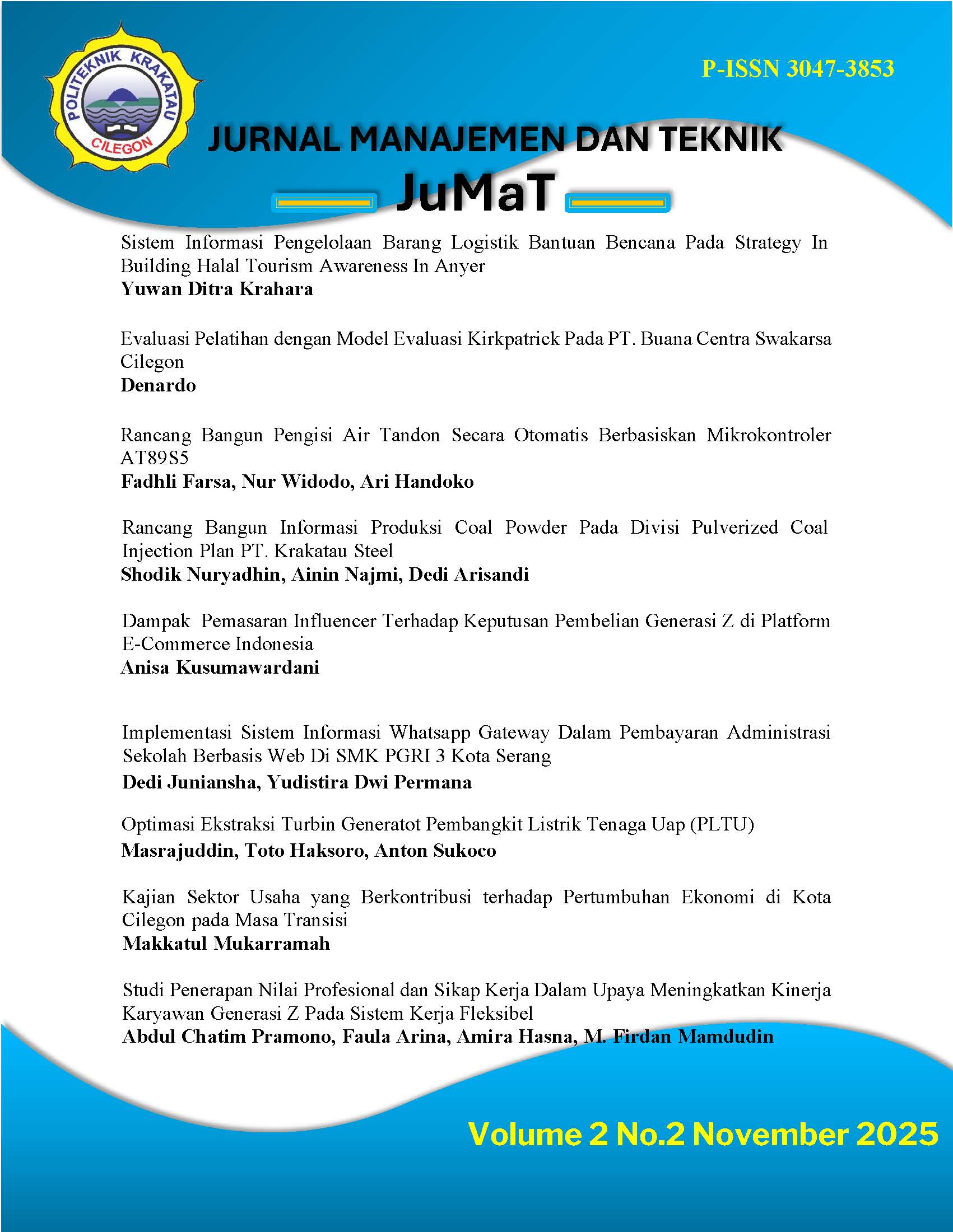
Studi Penerapan Nilai Profesional Dan Sikap Kerja Dalam Upaya Meningkatkan Kinerja Karyawan Generasi Z Pada Sistem Kerja Fleksibel
Abstract
The implementation of professionalism, commitment, and constructive work attitudes significantly contributes to improving the performance of Generation Z employees, especially within flexible work systems. This study explores the relationship between professionalism, commitment, and work motivation on individual productivity and their contribution to organizational effectiveness. Using a qualitative approach through literature reviews and limited interviews, the findings reveal that the synergy between professionalism, work commitment, and organizational culture positively influences productivity, employee loyalty, and overall performance. These findings are supported by previous studies emphasizing the crucial role of motivation, organizational culture, and organizational citizenship behavior (OCB) in enhancing optimal performance.
Keywords: employee performance, Generation Z, professionalism, work commitment, work attitude, flexible work
Downloads
References
Al‑Balushi, A. T. H., Bashayreh, A., & Jalagat, R. C. (2022). Assessing the impact of remote working, work-life balance, and organizational commitment on employee productivity. European Academic Research, 10(4), 1521–1538. Retrieved from https://www.researchgate.net/publication/362234494
Dessler, G. (2020). Human resource management (16th ed.). Pearson.
Frontiers Editorial Office. (2025). Does organizational citizenship behavior predict organizational commitment? [Figure illustrating OCB dimensions and their relationships]. In Frontiers in Education. Retrieved from Frontiers website
Great Place to Work. (2025). Employee productivity, March–August 2019 and 2020 [Grafik produktivitas karyawan]. Dalam Remote work productivity study finds surprising reality: 2-year analysis (hal. 4). Great Place to Work Institute. https://www.greatplacetowork.com/resources/blog/remote-work-productivity-study
Pramono, A. C., & Prahiawan, W. (2021). Effect of training on employee performance with competence and commitment as intervening. APTISI Transactions on Management (ATM), 6(2), 142–150. https://doi.org/10.33050/atm.v6i2.1742
Pramono, A. C., & Arina, F. (2024). Pengaruh motivasi dan budaya organisasi terhadap kinerja karyawan. Jurnal Manajemen Terapan (JuMat), 1(1), 1–12. https://jurnal.polka.ac.id/index.php/JuMat/article/view/6/6
Robbins, S. P., & Judge, T. A. (2019). Organizational behavior (18th ed.). Pearson.
Schaufeli, W. B., & Taris, T. W. (2014). A critical review of the Job Demands-Resources Model: Implications for improving work and health. In G. F. Bauer & O. Hämmig (Eds.), Bridging occupational, organizational and public health (pp. 43–68). Springer. https://doi.org/10.1007/978-94- 007-5640-3_4
Syah, R., Nurul, F., & Hasanah, N. (2024). The role of organizational citizenship behavior in mediating work stress and role ambiguity on employee performance. Jurnal Manajemen dan Bisnis Indonesia, 9(1), 55–64.
Structural Learning. (2023). Intrinsic vs. extrinsic motivation [Diagram tumpang tindih motivasi]. Retrieved from https://www.structural-learning.com/post/intrinsic-motivation
Twenge, J. M., & Campbell, S. M. (2012). Who are the Millennials? Empirical evidence for a generational difference in work values, attitudes and personality. Management and Organization Review, 8(1), 83–96. https://doi.org/10.1111/j.1740-8784.2011.00260.x
Downloads
Published
Issue
Section
License
Copyright (c) 2025 Abdul Chatim Pramono, Faula Arina, Amira Hasna, M. Firdan Mamdudin (Author)

This work is licensed under a Creative Commons Attribution 4.0 International License.